


The Nubian Museum: Dive Into the Legacy of Nubia Aswan
the Nubian Museum You know how there are some of those great, really significant Egyptian museums? This one might not be as prominent as those in the capital, but this has to be one of the top museum picks for anyone interested in the rich history, cultural traditions and ancient legacy of Nubia. If you want to make sure your Aswan travels bring you closer to this impressive civilization then you need to add the Nubian Museum to your Aswan travel itinerary!
Situated right in the heart of Aswan this museum will walk you through centuries of history and civilization of the Nubia region with amazing, carefully selected artifacts and exhibits.
Founded in 1997, the museum was born out of an international effort to conserve the Nubian heritage in light of Lake Nasser’s inundation, which rose as a result of construction on the Aswan High Dam, back in the 60s. Today, it continues to function as a cultural house of wonders showcasing what constitutes ancient Egyptian history, their connection with Nubia and its traditions that are very much visible in modern southern Egypt. From an architecture lover, an archaeologist or just the curious traveler to ancient Egypt, this will sure be an interesting visit and a nice compliment for the usual temples visits to Aswan.
Understanding Nubia: a Civilisation Older than many Egyptian Kingdoms
We use the term, Ancient Egypt, but it has not, and is probably still not generally appreciated that the Kingdom of Egypt was contemporary with that of the Nubians.
In the north, what we recognize as the Ancient Egyptians, have always lived in the so called Nile Valley and Delta, the more settled regions where agriculture flourishes well – and has for many thousands of years.
Further south, beyond these fertile regions, is Nubia. For a very long time this part of the Nile valley, stretching across the present day south-west corner of Egypt and north of Sudan was, with various other names, and under numerous names, subject to other, or other, rulers. For thousands of years however, the separate Nubian Kingdoms (or Kingdom, they waxed and waned in strength over the time.) have run concurrently and remained inextricably intertwined politically, socially, economically and religiously with their more north neighbours to such an extent that, at time of writing, and to a large extent today, in the minds of the uninformed, we can hardly distinguish these, or these separate states.
The Nubian Museum brings to light a great array of artifacts revealing the daily life and history of one of the earliest and greatest cultures in North East Africa; of people whose contributions continue to influence southern Egypt even to the present day. Many of them were able to seize control of Egypt; indeed for a while there was a group of so called Black Pharaohs who ruled both countries.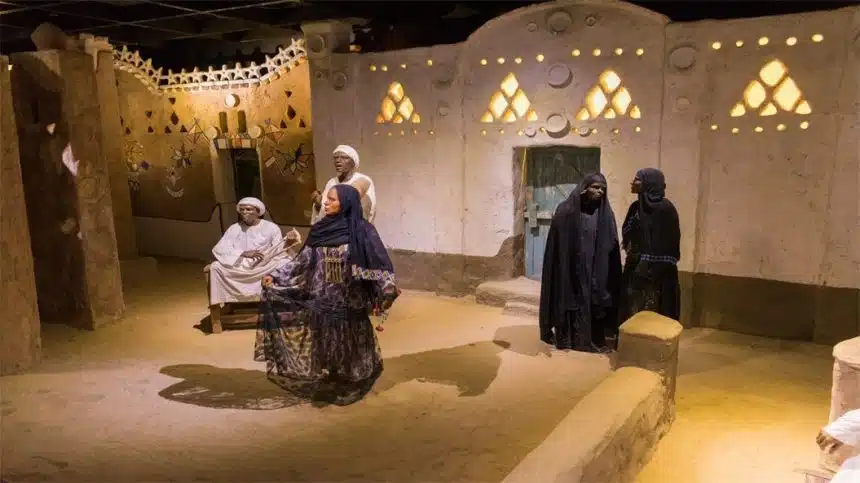
The Creation of the Nubian Museum Back to the present day.
The museum stands proudly on a hill to the north of Aswan, and represents part of a monumental international conservation effort carried out over the last half of the twentieth century. During the construction of the Aswan High Dam, an entire region – that historically known as Nubia – that straddled both countries would have found itself submerged as a consequence of the expanding Lake Nasser reservoir.
Luckily a vast effort coordinated by UNESCO saw numerous ancient archaeological monuments carefully documented, documented in situ , removed in pieces for reconstitution.
Some important sites were salvaged – like the great temples of Abu Simbel, some like Philae removed stone by stone to new locations where they can still be visited. During this international effort to save Nubian archaeological remains many items which were moved out of the region have found their way to this excellent Museum. The museum has been designed on three levels; built in the traditional style of Nubian village houses (but far larger), in close proximity to ancient Egyptian traditions, but retaining the feel of Egypt’s historical southward expansion.
Diving deep into the treasures inside the Nubian Museum
The museum’s extensive collections depict the rise of the Nubian civilization throughout millennia as visitors discover prehistoric artifacts, jewelry, pottery, statutes, ancient inscriptions and daily articles, highlighting how the Nubian people have been living, operating and worshipping in their communities throughout various time periods. This chronological walk-through ancient historical facts guides you along diverse stages of Nubian history; each and every artifact tells a story of early civilizations and intercourses with Egypt through the Pharaonic Age.
Walk amidst magnificently preserved statues of ancient kings, goddesses, and other figures, ceremonial crafts, and texts that offer insight into religious and political life.
What captures visitors most is seeing the artifacts of the Kingdom of Kush which established the authority to all of Egyptian Nubia, a leading power of their epoch whose ambitious rulers’ influence the country and who left behind a great legacy of awesome structures that still inspire researchers nowadays. Don’t forget to witness the other section dedicated to Islamic and Christian Eras in Nubia, and catch glimpses at the preserved writings, architectural debris, and artifacts of the period that show the evolution process throughout centuries.
The outdoor experience is to die for in the landscape of the Museum
In addition to the Museum galleries, the Nubian Museum boasts outdoor exhibiting premises.
Such exhibitions greatly add to the total tourist experience at the Museum as its design aims to simulate the authentic climate and scenery in Nubia with flora, waterscapes, and even the landscape in addition to natural-like rockeries and rock outcrops.
These include monuments that are recreated on site from stones carved on location or relocated architectural members and structures pulled out from submerged sites. By doing this, the Museum showcases the real environmental backdrop within which the showcased monuments stood, while also recreating the Nubian landscape on- site in a captivating method. This outdoor museum space itself, which is carefully landscaped with tropical plants, gardens and trees, is designed with peaceful and serene strolling trails.
Informative placards across the outdoor part introduce visitors to the background behind numerous monumental sites and works of restoration for these monuments.
Understand the culture and customs of Nubia It’s not the ancient history only that is found in the Museum.
Nubia is a place of culture too! You can have the knowledge of how the Nubians are living now as the Museum dedicated a portion of it to the Nubian lifestyle. You can have ideas about Nubians culture, music, arts, architecture and, in addition, traditions and clothing! Moreover, all these info is well supplemented with pictures, plans, audio recordings and videos, which will definitely enrich the Nubian culture knowledge you seek, all of which show you that the current traditions reflect the old heritage of nubians community.
Is the Nubian Museum worth visiting in Aswan
If you visit Aswan, whether for the purpose of looking at old castles, pyramids, monuments, or just having some rest then you shouldn’t definitely miss going to the museum in order to truly connect with the culture and people of ancient Nubian.
A large part of all of Aswan’s tour is focused at the temples that are very well known in the country of the pharaohs, such as temples like the PhilaeTemple, Unfinished obelisk or high dam Aswan and they are considered a major part of every travel itinerary of all the tourist itineraries all over Egypt. As for what i can tell, if you go through the Nubian museum earlier you will find out that understanding those sites. The museum, which has become a most visited attraction, features modern exhibition methods, user friendly display panels, well explained artifacts; it really presents to visitors all over the world how the Nubian culture played a really essential role in building the history of the world as it did for Egypt and Sudan, and if you are on your journey searching the history of pharaohs and their masterpieces you will definitely find satisfaction in visiting this exceptional masterpiece; which will surely make your journey even more enlightening and fun.